
Menu

Cooler farm stands: building an off-grid solar system

September 2026

The sun beckons seeds from sprouting to fruiting, so it’s fitting that it would preserve them after the harvest. Adding refrigeration to farm stands offers growers a practical way to preserve produce, reduce food waste, and boost direct sales even when far from electric utility lines.

The University of Minnesota Extension Regional Sustainable Development Partnerships (RSDP) have released a prototype for a solar farm stand model with a refrigerator.
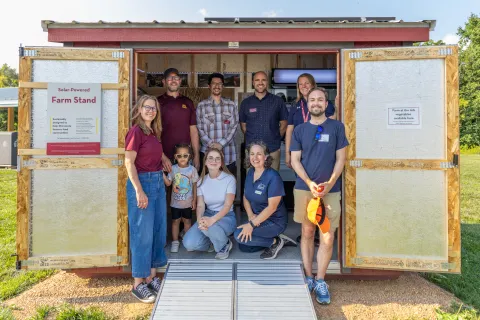
Nine people stand just inside a farm stand shed.

The team who worked on the solar farmstand model. (Photo Credit to Joel Morehouse.)
 

To show how this works in practice, RSDP Program Coordinator Zachary Paige teamed up with CERTs Renewable Energy Consultant Colby Abazs, along with Daniel Handeen and Olivia Kennerhed from the UMN Center for Sustainable Building Research, Minnesota Department of Agriculture's MN Grown program, and many local farmers. Together this team designed and field-tested the off-grid farm stand for practical use.
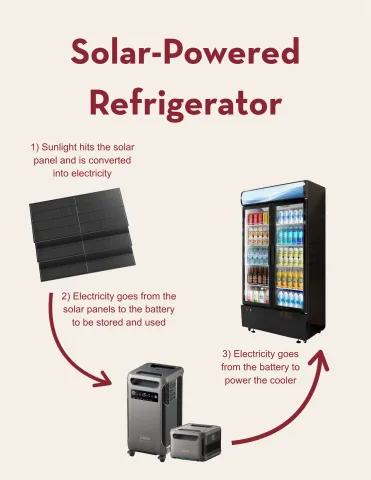
What’s in a solar system

Graphic of a solar panel with arrow to a battery and arrow to a fridge. The system includes a fridge powered by solar panels and a portable battery generator. During sunny hours, the solar panels power the refrigerator while also charging the batteries, providing enough energy storage to keep the fridge running overnight and through cloudy weather.
To make the entire system accessible to a novice, the team chose components that don’t require previous knowledge of solar systems or electric wiring, meaning they can be set up quickly and easily.

Abazs, who also runs an off-grid farm in northern Minnesota, says, “Off-grid solar and battery systems can power anything from small appliances to an industrial facility. The key is choosing the right components for your needs so you don’t overspend.”

Finding a fridge that fits

Building any off-grid system means balancing cost, storage capacity, and power output. Deciding on a refrigerator was the first step, because its load (the energy it uses) will dictate the rest of the equipment.

The team's primary challenge was balancing how large of a cooler was possible before running out of room for solar panels on the roof.

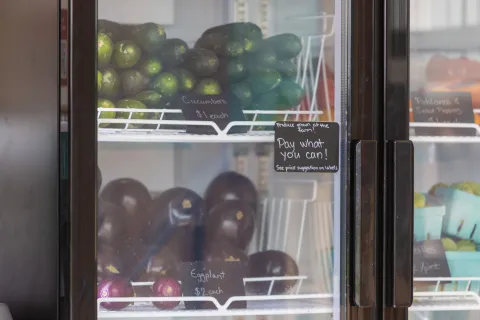
 Zucchini and eggplant with price tags in a refrigerator

Produce is displayed through glass doors on the cooler. (Photo Credit University of Minnesota Extension)

They also wanted to use a cooler with glass doors. This was important to the farmers because it would allow customers to view products, but from an energy standpoint this created a challenge. Glass-front coolers lose much more heat than solid-door models, so the solar system had to be larger to provide the additional power needed to keep the cooler cold.

Kennerhed worked extensively on the research and project design. This was Kennerhed’s first time working on a small, self-sufficient solar project.

When testing various fridges, Kennerhed was surprised by the variety of options. “The numbers almost felt too good to be true — the battery can be really small if an efficient fridge is used!”

Kennerhed says that although energy-efficient fridges cost more initially, people will save money in the long run by buying smaller batteries and fewer solar panels. 

Calculating energy to choose a battery

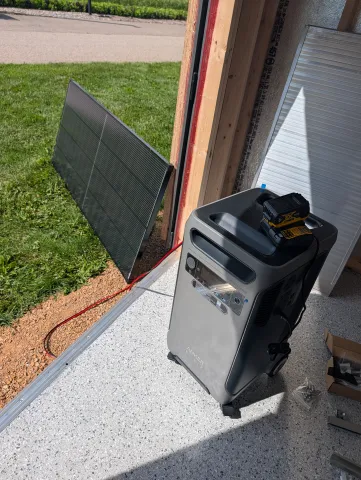
 A solar panel sits outside next to a large box in the shed.Considering the size of the farm stand’s roof and the power needed for the fridge, the team weighed the factors.
They needed a system that had consistent power. A dead battery could mean spoiled meat or eggs, which could hurt a farm’s profit. To prevent this, the team sized the battery system to keep the cooler running through three days of sunless weather.

Battery generators can have built-in or add-on features to track energy use and production. Paige recommends using these features to track real world energy production and use. Tracking this data allows farmers to predict energy requirements for specific timeframes, which can inform future decisions, such as setting up a new system or downsizing the current one if power generation exceeds actual needs.

Picking out solar panels

Having chosen a relatively inexpensive refrigerator paired with a battery to last three days, the team could then pick out solar panels.

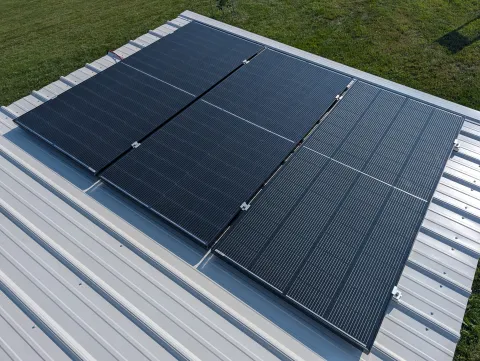
Solar panels come in many sizes and wattages, but how much energy collected per square foot is fairly consistent. Small portable or foldable panels are an attractive option and are often sold in kits, but many battery generators also work with full sized solar panels. These ‘normal’ or ‘contractor’ labeled panels tend to be cheaper and produce more power.

 Solar panels on top of the farm stand roof.

Solar panels on top of the farm stand roof.
 

“The first set of solar panels we ordered were mislabeled,” says Paige who received panels with incorrect wattage labeling that stated they were 400W - yet performing at 200W. Paige worked with Abazs to find the right equipment from a local solar installer.

Solar farm stand is ready to use

Setting up solar-powered, off-grid refrigeration takes upfront investment. The entire ready-to-use system costs between $10,000 and $13,000, covering both the structure and the solar equipment. Despite the estimated costs, Paige says that a well attended farm stand may be able to generate that amount of income in a season or two.

Because the solar design is flexible and modular, growers can start small and expand later.

Resources are available on the RSDP website for growers interested in learning how to size their equipment and build a farm stand shed. Looking forward, they are planning to release designs for a mobile farm stand on wheels, as well as additional resources to assist planning for different sized refrigerators.

Special thanks to Farm at the Arb at the Minnesota Landscape Arboretum for hosting the Solar Farm Stand and supporting the project as a living demonstration site. Growers and visitors are invited to see the prototype in person at Farm at the Arb during the 2026 and 2027 growing seasons.

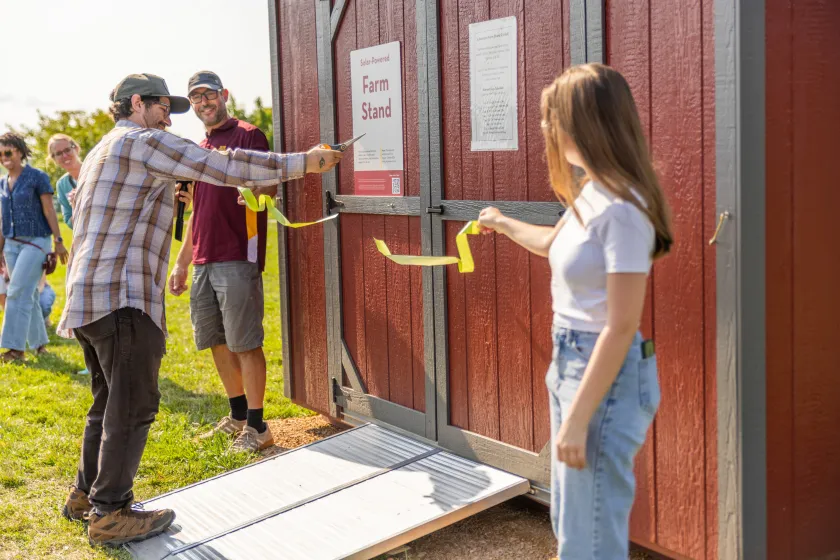
Two people hold a ribbon in front of barn doors while a third man cuts it.

Zachary Paige cuts the ribbon during an opening ceremony alongside Dan Handeen and Olivia Kennerhed. (Photo Credit University of Minnesota Extension)

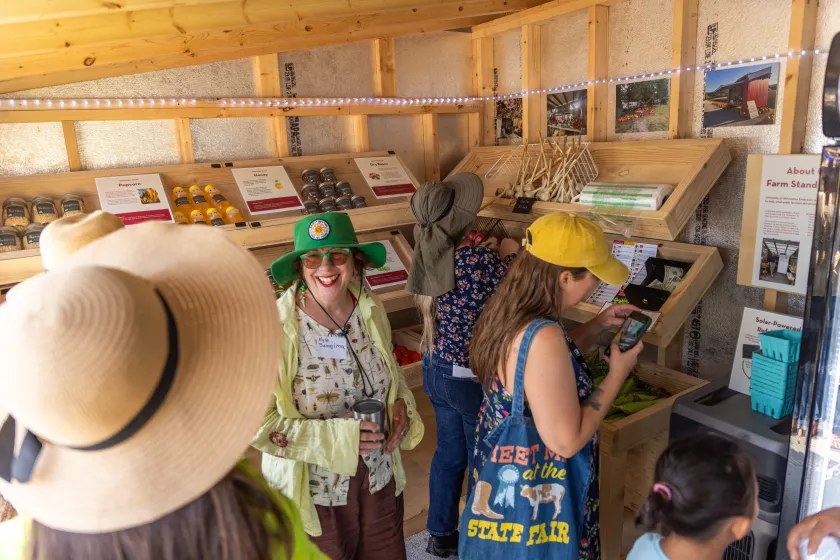
Four women examine products and chat in a small shed.

Ribbon cutting attendees shop in the farm stand prototype displayed at the University of Minnesota’s Farm at the Arb. (Photo Credit University of Minnesota Extension)

Building an off-grid solar system?

Looking to learn more about off-grid solar? Contact Colby Abazs at [email protected] to get started.

Sign up for Energy Stories

We encourage reuse and republishing of this story. All Clean Energy Resource Teams stories are made available under the Creative Commons Attribution license, meaning you can share and adapt the work as long as you give us credit. We'd also love it if you link back to the original piece. Have questions or want to chat? Drop us a line.