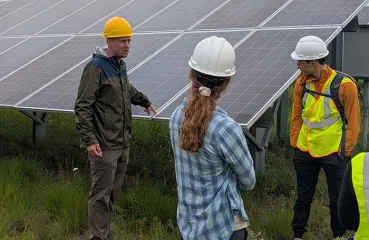
Technical assistance, or TA, is simply a service, expertise or resource that exists outside of an organization that can help fill a gap or advance a goal. If we imagine renovating a house, technical assistance makes sense, because unless I can do the whole thing myself, it’s expected that I’ll need to call in people who have all kinds of experiences and expertise. Climate and clean energy projects are no different. Each project stage from idea to operation requires some mix of money, information, and know-how. When we zoom out across the state and scan hundreds of unique grants, projects, and communities, you begin to see why technical assistance is daunting for anyone to find or sequence. What happens first? What happens next? How do we pay for this? Who can help? Without clear coordination between systems of people, information and money - great projects may not happen.
And that’s why the MN TA Collab exists! We’re here to map and bring semblance to this expansive ecosystem of technical assistance providers, funding, and resources to help move projects forward, stage by stage, place by place. We’re also here to listen, scope, connect, and support. And because no single person or organization can do or know everything, we invite TA providers to join us and share their piece of this statewide puzzle. Then it’s our job to bring structure to that puzzle and unlock what we know to as many people as we can. Our mission is to be a welcoming front door for TA providers and communities to find who and what they’re looking for, including each other. Also, we’re not a member-based organization - we’re an opt-in network, free to leverage and fairly informal - which I think are strengths.
My favorite part of the TA Collab is creating meeting spaces that remind us of how relational this work is. We’re not a statewide network of data points, we’re a network of people who come together in all kinds of big and small group configurations to share ideas, ask questions, and do better work together than we could do alone.
We remember the phrase “any door approach for technical assistance” when the MN TA Collab was first convened in 2024. How did this go from theory into practice?
If every TA provider or organization was a door, you could say we have hundreds of doors to knock on in Minnesota! That’s exciting but likely confusing for TA providers and communities alike. When we launched in 2024, we imagined a reality where knocking on any one of our doors could swing open 100 others. This any door approach is how we envisioned making technical assistance discoverable, accessible and better coordinated.
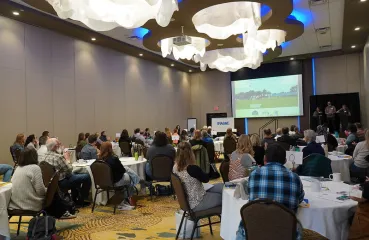
In the past 2 years, we’ve made progress in two ways. First, we’ve focused on building new relationships between TA providers. It’s impossible to refer a community to a person or resource you’re not aware of. Through our monthly meetings, joint webinars, small working groups, and our in person event last year, our TAs are connecting with each other, sharing resources, making referrals, and discovering new ways to partner. Second - in my role, I’m serving as a navigator and matchmaker for both TA providers and communities seeking support for projects. I’m fielding and responding quickly to all kinds of project requests. There’s a lot you can do when you have 100+ doors to knock on, and often, I’m bringing small bands of TA providers together to collaborate on a project.
Can you walk us through some of the larger resources of the MN TA Collab?
Absolutely. One tool is our Minnesota Climate & Clean Energy Grants Tracker. We’re solving the problem of duplicative grant research across hundreds of people sinking lots of time doing the same thing. In this case, it’s searching for grants and compiling key details across dozens of federal, state and philanthropic websites. A community can’t apply for a grant they don’t know about, which is why it’s crucial to centralize and democratize grant information. Instead of existing behind a paywall or requiring a membership, our grant tracker is a free, public tool. In fact, anyone can embed it on their own website to share with their local partners.
We also aggregate events and learning workshops, including informational webinars for funding opportunities - since those are hard to keep track of. It’s a great tool to reference if you want to tap into what’s happening around the state. For our TA providers, we send monthly resource round-ups and host joint webinars, which oftentimes are open to community partners. We’re planning two public webinar series launching this summer and fall - Green Lending for Green Projects coordinated with several partners, and All Things Geothermal in Minnesota which we’ll co-host with GPI and others who are advancing this renewable technology in Minnesota.
A recent tool you created is the Minnesota Climate Action Plans Dashboard. Wow, what a resource! How can you imagine people utilizing this information?
The dashboard (located on the main web page) is a discovery tool and conversation starter about the plans and aspirations of individual cities, counties, regions, Tribes, and campuses. It tests the theory that we can bring more plans to life if we know they exist. The dashboard links 451 discrete plans across 1056 entities and can help anyone discover the climate and energy-related priorities of a neighboring town or Tribe, or maybe even their own city and county. By taking a peek, you may find an exciting new reason to engage with a city or Tribe, learn about their planning process, or offer support. Regional coordinators may be surprised to discover local plans to they didn’t know existed, and communities can glean ideas or find new partners.
This effort was prompted by four resources: the Minnesota Climate Action Framework revised in February, the Minnesota Sustainability Index managed by MPCA and GreenStep Cities, 100 Percent Minnesota which tracks local climate plans, and MPCA Local Resilience and Climate Adaptation Planning Survey.
After reflecting on these, we asked - do we have a comprehensive index of all plans across the state that include climate and energy action goals? After scouring 1000s of websites, we identified plans that weren’t accounted for on other sites. We also confirmed that some entities embed climate and clean energy goals inside planning documents that may not explicitly be climate or energy action plans, such as comprehensive, transportation, or hazard mitigation plans. We also realized that some county and regional plans “cover” or include multiple cities or towns, which uncovers a nuanced reality of just how many entities in Minnesota have climate and energy plans underway.
Finally, a self-serving question from CERTs: If someone was working on becoming a Community Energy Ambassador, what are a couple of tips on how they might use the MN TA Collab website to help them with their final project?
Check out the Local Climate Action Plans Dashboards and the entities in your region! You may be inspired by a city or Tribe doing something interesting and you want to reach out to learn more. Or, you might recognize some overlap or alignment across several places, which could spark a reason to bring people together or share a funding opportunity you know about.
My last hopeful tip — come knock on my door and say hello! You can email me at [email protected], and my number is in my signature — I’m a huge fan of a good old-fashioned phone call! I’d love to hear what you’re working on and dream up what we can do together.