Siting and Permitting Renewable Energy
This guide offers information to help you understand renewable energy development, siting, and permitting in Minnesota. We will update this content over time to keep you informed.

This guide offers information to help you understand renewable energy development, siting, and permitting in Minnesota. We will update this content over time to keep you informed.
Our electric grid is a network of equipment that captures, converts, stores, and delivers power.
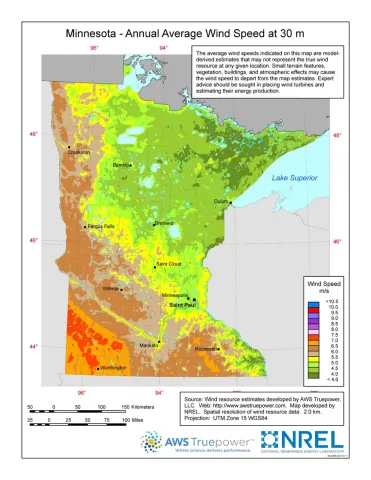
Minnesota has rising demand for electricity, and as electric utilities work to meet that demand, they are investing in both energy efficiency and renewable energy. Because of our geography, Minnesota has rich solar and wind resources, especially in the southern and western areas of the state.
As solar and wind technologies have improved and as their cost has declined, the number of projects has increased. The first wind farm cluster in Minnesota was built in the Buffalo Ridge area (northwest of Lake Benton) in 1994. Those first projects were expensive, but by 2011, costs of wind development had dropped dramatically, and wind energy had become the least expensive form of energy generation. The cost of solar development took a little longer to come down, but now has become comparable to the cost of wind development, based on their “levelized cost of energy.”
| Levelized cost of energy (LCOE) is a way to compare the cost-effectiveness of different types of energy generation. It is based on the costs of building and operating an energy generation facility over its lifetime, relative to the amount of energy it will generate over its lifetime. |
In Minnesota, the economic case for renewable development is also backed up by policy: Minnesota’s Clean Energy by 2040 Law, signed in 2023, requires electric utilities to provide 100% carbon-free electricity by 2040. The legislation sets interim targets of 80% carbon-free by 2030 (60% for non-investor-owned) and 90% by 2035.
Track progress toward the targets on the Minnesota Energy Data Dashboard.
The size of renewable energy projects is described by their rated capacity: the rate at which they can produce energy (their power). This is measured in kilowatts (kW) for small projects and megawatts (MW) for large projects. 1 MW = 1000 kW
Small-scale projects:
Large-scale projects:
The first thing that developers look for is whether there is ample wind or sunshine at a site.
| Map: Minnesota – Average Annual Wind Speed at 30m | Map: Minnesota Solar Suitability App |
 |
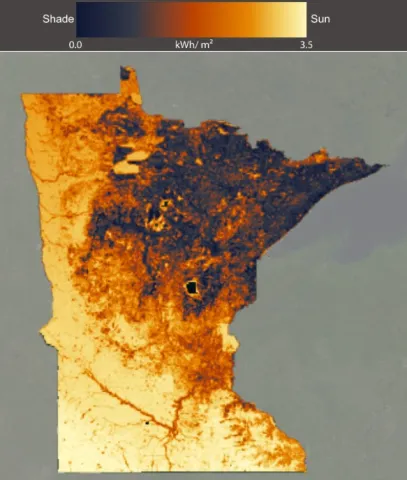 |
For solar projects, development is simplest on open terrain that is easily accessible and receives full sunlight.
For wind projects, development makes the most sense on plains and agricultural land because they offer consistent, predictable wind directions and easy construction access.
Building new transmission lines and substations is costly and time-consuming, so developers prefer to locate their projects where grid capacity already exists. Early in the siting process, developers review maps and data from utilities and transmission operators to identify the best locations to explore in greater depth.
Land acquisition for solar and wind projects involves either long-term lease agreements or purchasing land. This typically takes 6-12 months. Once a developer has identified their preferred sites, they conduct title searches, negotiate with landowners, and navigate zoning regulations. Developers often prefer long-term leases (typically 20-30 years), rather than purchasing the land. This reduces the project’s up-front costs, and landowners receive a steady income (either royalties or per-acre payments) while retaining ownership.
In Minnesota, solar, wind, and battery projects are regulated through a combination of local zoning ordinances and state-level permitting. Whether a particular project falls under state or local decision making is based on the size of the project: smaller projects are permitted through local (usually county) processes, while larger projects are permitted through State processes at the Minnesota Public Utilities Commission (PUC).
| Project Type | Local | Minnesota PUC |
|---|---|---|
| Solar Photovoltaic (PV) | Up to 50 MW | Larger than 50 MW |
| Wind Energy Conversion Systems (WECS) | Up to 5 MW* | Larger than 5 MW* |
| Battery Energy Storage Systems (BESS) | Up to 10 MW | Larger than 10 MW |
| * Local governments can request authority for wind up to 25 MW. | ||
In both cases, rules often address concerns like setbacks from homes, noise, and decommissioning plans, with specific protections for agricultural land, wildlife, natural resources, roads, and other considerations.
Projects that fall under local authority are handled by the city or county through local zoning ordinances and permitting processes. Zoning approvals must include opportunities for community members to voice support, concerns, questions, or interests at public hearings.
For projects that are permitted at the state level, the following process is followed:
A final decision on a permit application must be made within six months of the date the PUC determines an application is complete. The PUC may extend the time limit for up to three months for just cause or upon agreement with the applicant.
Visit the PUC’s Energy Infrastructure Permitting page to learn more about the permitting process.
Acknowledgment: This material is based upon work supported by the U.S. Department of Energy Office of Critical Minerals and Energy Innovation (CMEI) through the Reliable Energy Siting through Technical Engagement and Planning (R-STEP) program. R-STEP is administered with support from the Partnership Intermediary Agreement (PIA) that the U.S. Department of Energy (DOE) has established with ENERGYWERX.
The views expressed herein do not necessarily represent the views of the U.S. Department of Energy or the United States Government.